Thomas Square
Place: Thomas Square, Honolulu, Oʻahu
Type: Historic park / sovereignty site
Story it tells: A Honolulu park named for the British admiral who restored Hawaiian sovereignty after the unlawful British occupation of 1843.
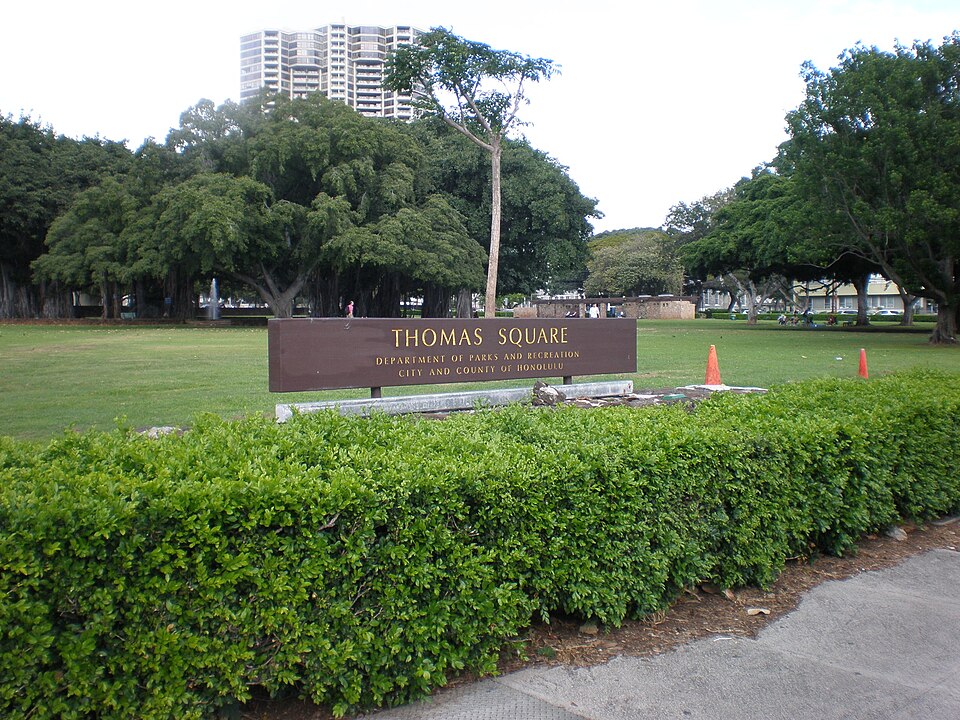
Thomas Square is a historic public park in Honolulu named for British Admiral Richard Darton Thomas. In 1843, Lord George Paulet of HMS Carysfort unlawfully seized the Hawaiian Kingdom during what became known as the Paulet Affair. Admiral Thomas later sailed to Honolulu to investigate the occupation and restored sovereignty to King Kamehameha III.
On July 31, 1843, the Hawaiian flag was raised again in a public ceremony at the site now known as Thomas Square. During that restoration of sovereignty, Kamehameha III declared the words “Ua mau ke ea o ka ʻāina i ka pono,” often translated as “The life of the land is perpetuated in righteousness.” The phrase later became Hawaiʻi’s state motto and remains one of the most important political statements in Hawaiian history.
Kamehameha III named the site Thomas Square in honor of Admiral Thomas, whose intervention ended the British occupation. The square was formally enlarged by the Privy Council in 1850, making it one of Hawaiʻi’s oldest public parks. Unlike most parks in Hawaiʻi, Thomas Square is also one of the few places where the Hawaiian flag may fly alone without the United States flag, reflecting its direct connection to the restoration of Hawaiian sovereignty.
Over time, Thomas Square became part of Honolulu’s civic landscape, with paths, trees, a bandstand, memorial features, and later renovations reshaping the park. In 2018, a bronze statue of Kamehameha III was dedicated there during the 175th anniversary of Lā Hoʻihoʻi Ea, or Restoration Day. The statue and flagpole returned visual focus to the event that gives the park its meaning.
Today, Thomas Square remains both a city park and a sovereignty site. Its name honors a British admiral, but the deeper story belongs to the Hawaiian Kingdom, the return of its flag, and the phrase that still defines Hawaiʻi’s political identity: “Ua mau ke ea o ka ʻāina i ka pono.”