
Russian Fort Elizabeth (Pāʻulaʻula)
Place: Russian Fort Elizabeth / Pāʻulaʻula, Waimea, Kauaʻi
Type: Fort / historical site / political landmark
Story it tells: A rare moment when Russian imperial ambitions, Hawaiian politics, and Kauaʻi’s independence intersected in the early 1800s.
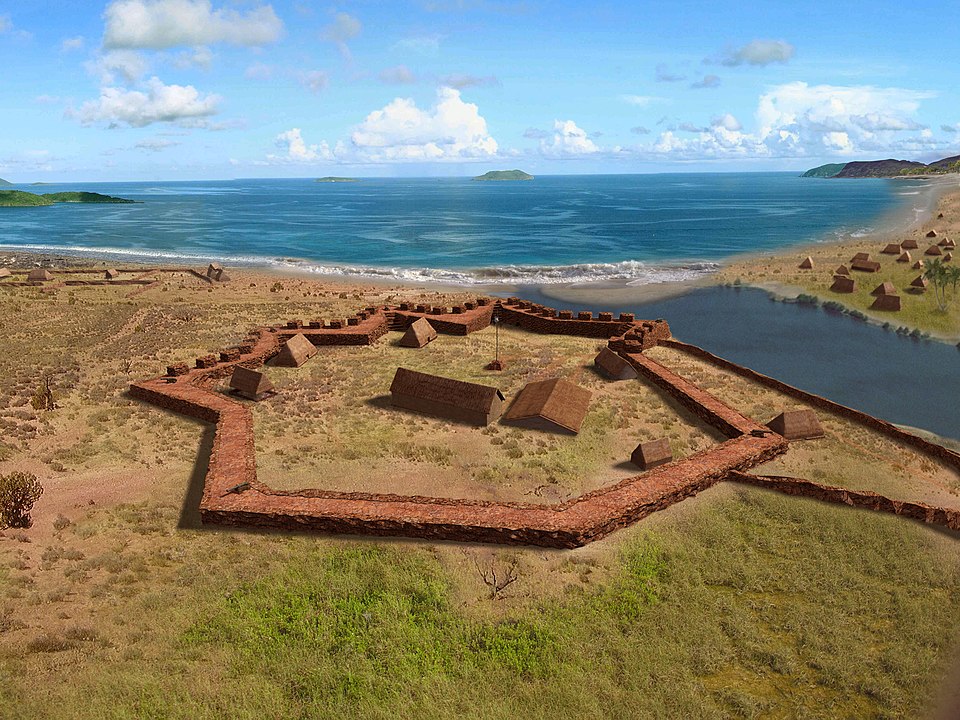
Russian Fort Elizabeth, also known as Pāʻulaʻula and later Fort Hipo, reflects one of the most unusual political episodes in Hawaiian history. Built near Waimea on Kauaʻi in 1817, the fort emerged during a brief attempt by representatives of the Russian-American Company to establish influence in the Hawaiian Islands.
The effort centered around German physician Georg Anton Schäffer, who arrived in Hawaiʻi as an agent of the Russian-American Company after a trading dispute involving Kauaʻi chief Kaumualiʻi. At the time, Kaumualiʻi was navigating the difficult political reality that followed the rise of Kamehameha I and the unification of the islands under the Kingdom of Hawaiʻi. Although Kaumualiʻi had formally agreed to Kamehameha’s authority in 1810, he continued searching for ways to preserve Kauaʻi’s autonomy.
Schäffer believed Russian support could establish a permanent foothold in Hawaiʻi, while Kaumualiʻi may have viewed the relationship as a possible counterbalance against Kamehameha. Under this arrangement, the fort at Waimea was constructed and named in honor of Empress Elizabeth of Russia through the Russian-American Company. Other smaller Russian-associated forts were also attempted on Kauaʻi during this period.
The Russian presence in Hawaiʻi ultimately proved short-lived. Schäffer lacked official backing from the Russian government, and opposition from both Hawaiian and foreign interests quickly undermined the effort. By the end of 1817, the Russians had departed Kauaʻi and the fort came under the control of the Kingdom of Hawaiʻi, where it later became known as Fort Hipo or Pāʻulaʻula o Hipo.
Today, the remains of Pāʻulaʻula State Historical Park stand as the last surviving Native Hawaiian-era fort in the islands. The site reflects not only a strange encounter between Hawaiʻi and imperial Russia, but also the political maneuvering, diplomacy, and uncertainty that shaped Hawaiʻi during the early nineteenth century.