
Diamond Head (Lēʻahi)
Place: Diamond Head / Lēʻahi, Oʻahu
Type: Volcanic crater / landmark / cultural landscape
Story it tells: A Hawaiian landmark whose English name emerged from a colonial misunderstanding of sparkling volcanic crystals.
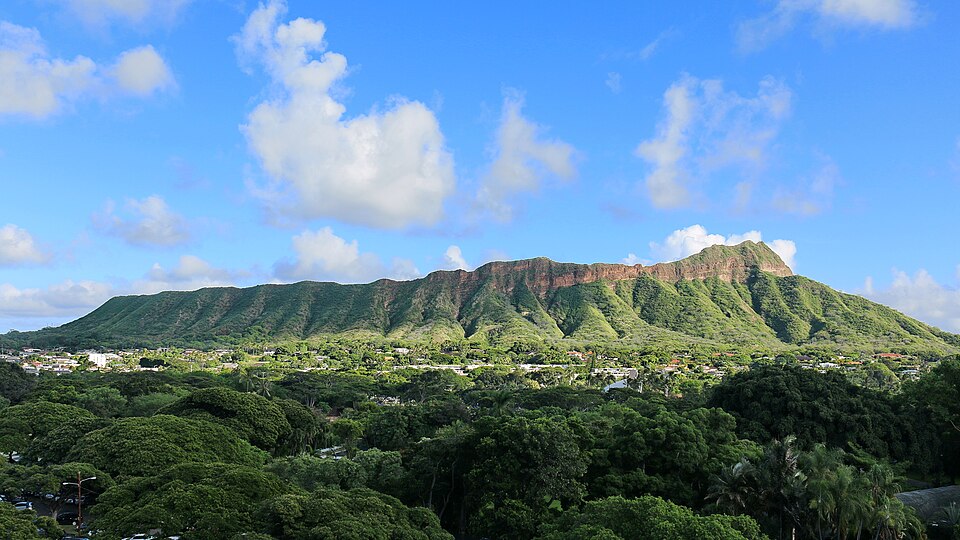
Diamond Head, known in Hawaiian as Lēʻahi or Laeʻahi, rises above Waikīkī on the south shore of Oʻahu. The Hawaiian name has been interpreted as “brow of the ahi fish,” tied to a comparison made by Hiʻiaka, sister of Pele, who described the ridgeline as resembling the brow (lae) of an ahi. The shape of the crater became part of the way Hawaiians described the landscape before the arrival of foreigners.
The English name emerged in the early 1800s when British sailors noticed sparkling calcite crystals in the volcanic rock and mistakenly believed they had found diamonds. The area became known as Diamond Hill, later revised to Diamond Head. Another local variation, Kaimana Hila, also reflects this misunderstanding.
Geologically, Diamond Head is part of the Honolulu Volcanic Series, a collection of much younger eruptions that formed long after the Koʻolau Volcano itself went dormant. These later eruptions created several of Oʻahu’s most recognizable landmarks, most notably: Punchbowl Crater, Hanauma Bay, and Koko Head. Diamond Head itself is estimated to be approximately 450,000 years old, far younger than the Koʻolau Range.
In the early 1900s, the crater became strategically important to the United States military. Fort Ruger was established within and around the crater as part of Oʻahu’s coastal defense system. Tunnels, bunkers, and observation stations were built into the landscape, some of which remain today. The hiking trail to the summit, originally constructed in 1908 for military purposes, now draws visitors seeking panoramic views of Waikīkī.
Today, Diamond Head is both a State Monument and a National Natural Landmark. It remains one of the most recognizable images associated with Hawaiʻi, appearing constantly in postcards, films, tourism campaigns, and skyline views of Waikīkī. Yet the traditional name, Lēʻahi, preserves the stories and observations of the past.